Voice memo journaling: what works, and where it quietly falls apart
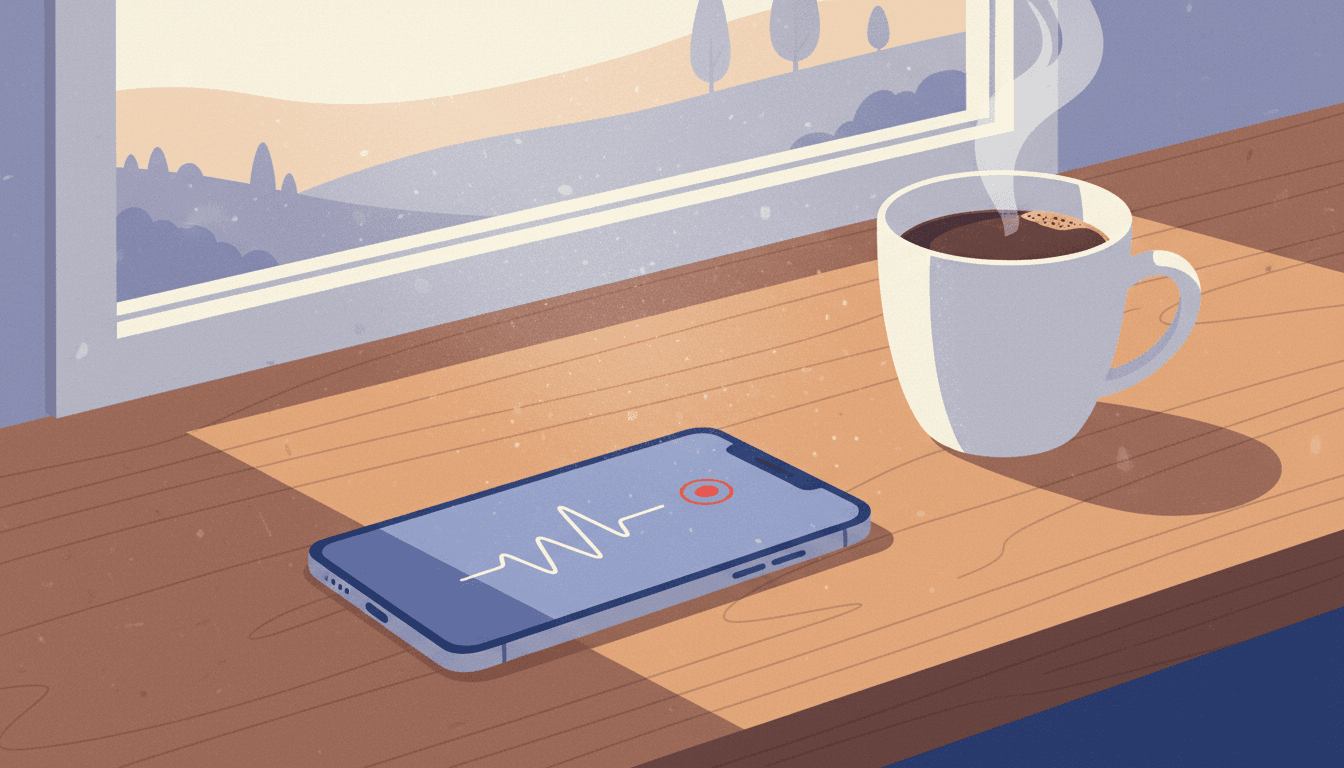
For about a year my journal was the voice recorder that came with my phone. Not an app I chose, just the grey icon that was already there. I would be walking somewhere, a thought would land, and I would tap record and talk for a minute. Voice memo journaling, if you want to call it that, though at the time I would not have called it anything. It was just the fastest way to get a thought out of my head before it left.
Capturing was never the problem. That is the part everyone gets right and it is worth saying plainly, because it is genuinely good. Talking is faster than typing and much faster than handwriting. I speak at maybe a hundred and thirty words a minute and type at sixty, so a thirty second recording holds more than a paragraph I would have laboured over. One tap, no blank page, no template asking me how I feel on a scale of one to five. You can do it on a walk, in a taxi, lying in bed with the lights off. This is the appeal of audio journaling in general: it takes the friction of the blank page and removes it entirely. For getting the thought down, the recorder app is close to perfect.
Where voice memo journaling quietly falls apart
The trouble starts the moment you want to do anything with what you recorded. And it starts slowly, which is why it took me a year to notice.
First, the list. After a few months I had a long scroll of entries called New Recording 47, New Recording 48, on and on, each one a grey bar with a length and a date and nothing else. No idea what was in any of them without playing it. A journal you cannot skim is a journal you never open, and I did not open it.
Then there is no transcript, so there is nothing to search. I knew I had talked myself through a work decision sometime that spring. Finding it meant scrubbing through fifteen minute recordings hoping to catch the right sentence, which I was never actually going to do, so the thought may as well not have been saved at all.
And listening back is worse than reading back. Reading a paragraph takes ten seconds. Hearing yourself say it takes as long as it took to say in the first place, plus the small wince of hearing your own voice. I almost never went back, and a journal you never revisit is just a pile of voice notes with your voice in them.
A journal you cannot skim is a journal you never open.
None of this is the recorder app failing at its job. It is a recorder. It records. The mistake was mine, asking a capture tool to also be an archive, which are two different things that happen to start with the same tap.
The real gap is between capturing and revisiting
This is the same lesson I keep running into everywhere, with highlights in paper books, with notes, with photos I take and never look at again. The satisfying part is the capture. The valuable part is the return, weeks or months later, when you can see what you actually thought at the time rather than what you now remember thinking. Voice memos are all capture and no return. That is the whole failure in one line.
Half the point of keeping a journal is being able to read it back. If the format makes reading back this awkward, you have a diary that only records and never plays, and eventually the recording stops too, because some part of you knows nobody is ever going to listen.
How to make voice memos actually work as a journal
If you want to keep using the recorder app, and there is a real case for it because it is already on your phone and it is free, a few habits close most of the gap.
- Rename each entry the second you finish it. Three or four words about what it was, while you still remember. It is the difference between a searchable list and a wall of New Recording 47.
- Get a transcript. Newer phones can transcribe recordings, and if yours cannot, a transcription app will. Text is the thing you can skim, search and paste into wherever your notes live.
- Do one listen-back pass on a schedule. Sunday evening, say, go through the week's recordings and keep the two or three that mattered. Most of it you will happily delete, and deciding once at a fixed moment is the whole trick.
- Move the keepers somewhere that is not the recorder. A note, a doc, a folder. The recorder app is where entries go to be forgotten, so do not let that be their final home.
That is more steps than tapping record, which is exactly why most people, me included, struggle to keep it up. Every one of those steps is a chance to fall off, and the one that always got me was the listen-back. It just never happened.
Where I landed
I ended up building the thing I wished the recorder app was, which is not a neutral position to write from, so take it as a bias I am naming rather than hiding. The short version is that I wanted the one tap of the recorder with none of the aftermath. Talk, and have it transcribed and titled for me so the list reads like a journal instead of a stack of files. Keep it on the device rather than on someone's server, because it is a diary. Let me export the lot to Notion or a plain CSV whenever I want, so nothing is ever trapped. That is Luna Journal, and it exists because voice memo journaling was so nearly right and only fell apart on the boring parts.
You do not need my app to fix this, though. You need a transcript, a name on each entry and a weekly moment where you actually go back. The recorder can do the first, your thumbs can do the second and only you can do the third. That last one is the whole game, and no tool has ever done it for anyone.
If there is a year of unnamed recordings sitting in your phone right now, do not try to process all of them. Start naming the new ones and let the old pile be. The habit you can keep beats the backlog you never will.
Luna Journal
A journal that fits into your day. You speak, and Luna turns it into entries you can read back and reflect on. Organised with AI, and kept on your device rather than a server.

More from the devlog.
How to find the best time to call someone across time zones
The weekly call home kept slipping, and "sorry, did I wake you" got old fast. Here is how I find the best time to call across time zones now, after years of getting it wrong while living abroad.
Why my Notion second brain kept failing (and what finally stuck)
I built beautiful, over-engineered Notion setups and stopped opening every one of them. Here is why a Notion second brain keeps failing, and the much smaller version that finally stuck.