How to stay active when you work from home
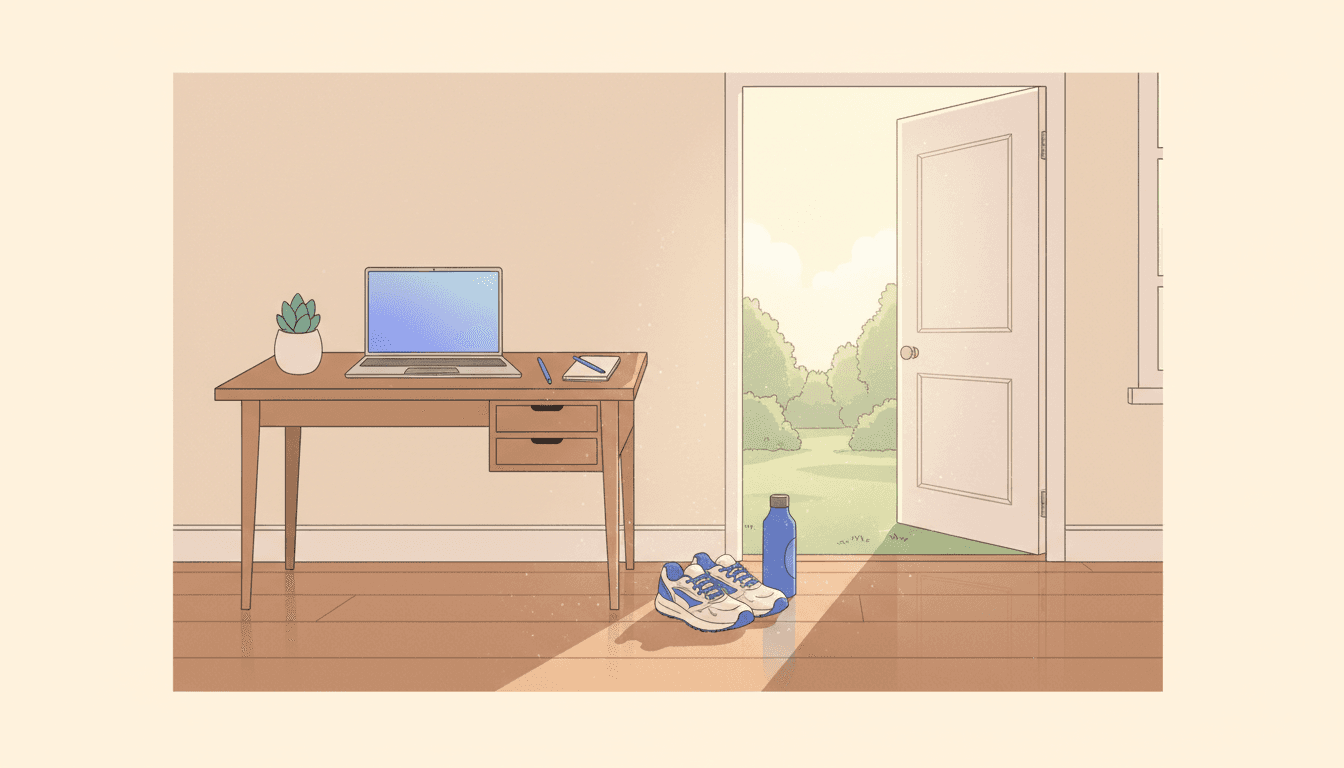
The thing nobody warns you about working from home is how little you move. There is no walk to the station, no stairs at the office, no wandering over to someone's desk to ask a question. Some days I have looked up at six in the evening and worked out that the only walking I had done was between my desk and the kettle. So when people ask me how to stay active when you work from home, I have stopped answering it as a fitness question. It is really a logistics one.
I work remotely, often from a co-living somewhere in Asia rather than an actual home, but the shape of the problem is identical. Take away the commute and you take away all the movement you never had to think about. What is left is a chair, a laptop and a very short trip to make tea. Left alone, that adds up to a body that slowly seizes.
Why working from home quietly makes you sedentary
A normal commute plus an office does a lot of quiet work for you. Walking to and from transport, stairs, the trip to lunch, the loop to a meeting room. None of it feels like exercise, but it is easily three or four thousand steps before you have done anything on purpose. From home you can reach lunchtime on a few hundred steps and not notice, because nothing in the day asks you to stand up.
I am not writing this as someone who has it sorted. A couple of winters ago I got sick in Tokyo and barely left the flat for the better part of a week, and even once I was better the not-moving had become the default. It took a while to climb back out. The point is that staying active when you work remotely is not about willpower on any single day. It is about the day being built so that sitting still for ten hours is not the path of least resistance.
Aim for a moving day, not a workout
The mistake I made for a long time was thinking the answer was a proper training habit. A 6am gym slot, a programme, the whole transformation. It never held, because it was one heroic thing balanced against a completely sedentary day, and the sedentary day always won in the end.
What actually works is lowering the bar and widening it. The goal for a workday is simply to move often, in small amounts, threaded through the hours you are already at the desk. A moving day beats a perfect workout followed by nine hours of stillness. This is the whole idea behind exercise habits that stick: they are small enough that a bad week does not break them.
A moving day beats a perfect workout followed by nine hours of stillness.
Attach movement to things you already do
The reliable trick is to bolt movement onto things that happen anyway, so you are not relying on remembering. My working day has a few of these now, and none of them feel like effort:
- The first call of the day I take walking, outside if the weather allows, pacing the room if it does not. Audio only, no camera.
- Every time I refill my water I do a lap of wherever I am staying, or a short set of something. The water runs out often enough to be a decent timer.
- Anything I can read rather than type a response to, I read standing up or walking. Long documents do not need me sat down.
- One coffee a day comes from a place a ten minute walk away, not the kitchen. It is a small bribe to leave the building.
None of that is a workout and that is the point. It is just moving more during the workday, folded into the day rather than added on top of it. On the days everything else falls apart, this is the part that survives, because it was never a separate thing I had to find time for.
Protect a few fixed points in the week
Small movement keeps you from seizing up, but it will not make you fit on its own. For that I keep two or three fixed points in the week that are genuinely non-negotiable, and I let everything else be flexible around them. A run three mornings a week, first thing, before the laptop opens. Something bigger at the weekend, a long hike or a dive when I am near the coast, or a dance class in whatever city I am in.
The fixed points do two jobs. They are the actual training, and they are the scaffolding the loose stuff hangs off. When the week has three anchored sessions in it, the small movement between them feels like part of a pattern rather than a lonely effort. Miss all of them and the small stuff quietly stops too.
I put the run in the morning for one boring reason: by the evening there is always a good excuse, and there rarely is one at 7am. That is not discipline, it is just removing the argument before it can start.
Make the active choice the frictionless one
Most of whether I move on a given day is decided the night before, by how much friction sits between me and the active option. So I take the friction out. Running shoes and clothes are by the door, not in a drawer. If I have a pull-up bar it goes in a doorway I walk through constantly, so it is a thing I pass rather than a thing I visit. The kit for the morning is out before I sleep.
It sounds trivial and it is the single highest-return thing I do. Every extra step between you and the shoes is another place the day can talk you out of it. Make the healthy choice the frictionless one and you spend your limited willpower on work, not on relitigating whether to go for a run.
Keep it going when you travel or the routine breaks
Because I move around, my routine breaks constantly. New city, no gym, an unfamiliar neighbourhood, a body clock that has no idea what time it is. For a while I treated a broken routine as a write-off, told myself I would restart properly next week, and lost a fortnight every time.
The fix was having a minimum version that counts. On a travel day or a wrecked day, a twenty minute walk is the whole target, and it explicitly counts as a win rather than a failure to do the real thing. Staying healthy working remotely is mostly this: refusing to let it be all or nothing. A short walk in a new place doubles as getting your bearings, which makes it easier to actually do than a workout you have no setup for.
The version of this I trust is dull on purpose. Move a little, most hours, most days. Guard a few real sessions. Take the friction out so the choice is easy. Have a floor you drop to instead of quitting. It will not give you a dramatic before and after, but it keeps the thing that working from home slowly erodes, and after a few years of doing it across a handful of countries, dull and durable is the version I would pick every time.
If you take one thing from this, put your shoes by the door tonight. The rest is easier to argue yourself into once that decision is already made.

More from the devlog.
Voice memo journaling: what works, and where it quietly falls apart
I used my phone's voice recorder as a journal for a year. Capturing thoughts was easy. Reading them back was where voice memo journaling quietly fell apart, and here is what I do about it now.
How to find the best time to call someone across time zones
The weekly call home kept slipping, and "sorry, did I wake you" got old fast. Here is how I find the best time to call across time zones now, after years of getting it wrong while living abroad.