Does Oura track your alcohol intake? What a ring can and can't do
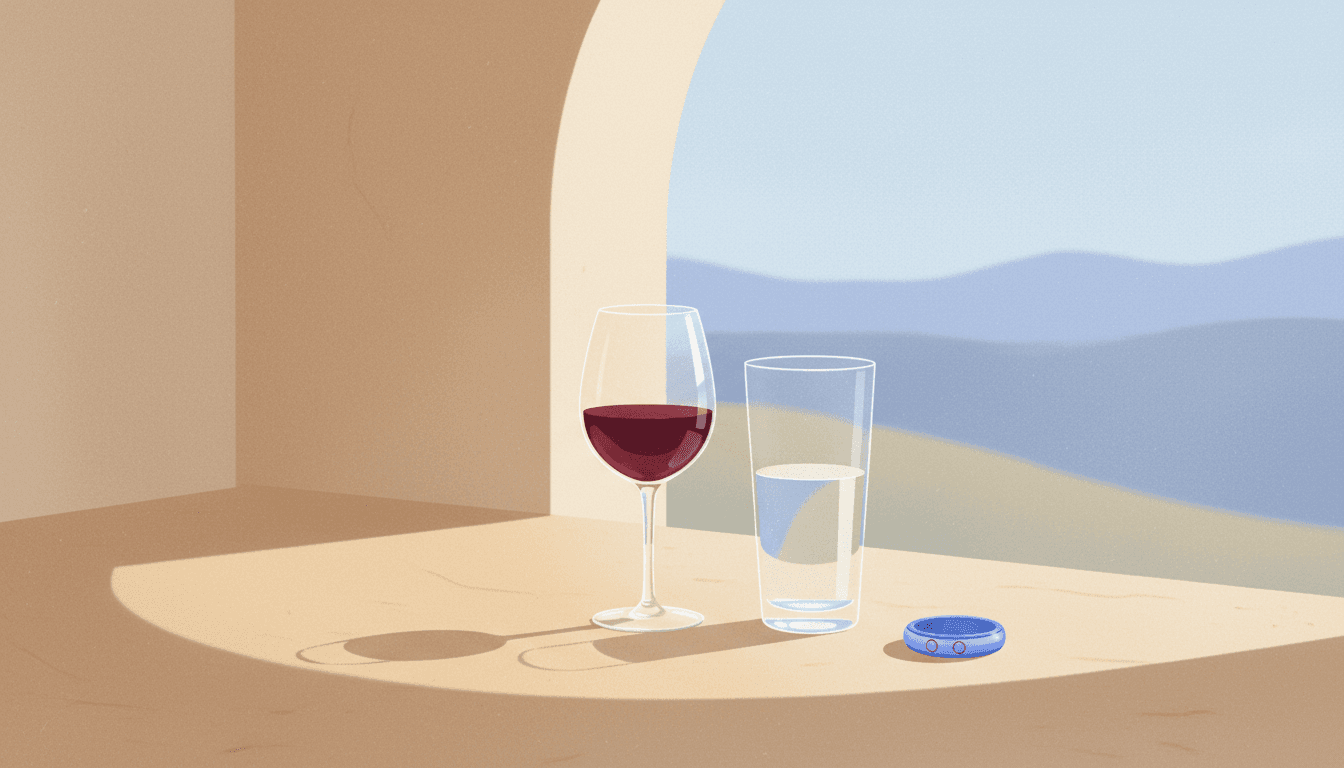
No. Oura does not track your alcohol intake. It cannot see what is in your glass, so it cannot count your drinks or add them up for the week. What it does is read how your body reacts on the night you drink, and only if you remember to tag that you drank at all. Whoop is the same. A ring or a band measures the after-effects. It does not measure the intake.
I worked this out the slow way. I wear a ring to bed most nights, and for a while I half assumed it was quietly keeping tabs on my drinking. It wasn't. It was telling me my sleep was worse and my resting heart rate was up, which I could mostly feel anyway, and leaving me to join the dots back to the two pints and a glass of wine from the night before. Useful, but not the thing I actually wanted, which was a straight answer to "how much did I drink this month".
What Oura and Whoop actually measure when you drink
When you have a few drinks, the alcohol shows up in your overnight numbers. Oura's own analysis of more than 800,000 members found that on a typical night with alcohol, sleep scores dropped by about 8 percent and heart rate variability by nearly 23 percent. Whoop reports the same pattern in its recovery score. Lower HRV, higher resting heart rate, worse sleep.
So the ring is genuinely good at one job: showing you the cost. You drank, your body paid for it overnight, and the next morning the graph is a bit flatter than usual. That can be a real nudge. Seeing the dip in black and white is harder to argue with than a vague sense that you feel rough.
But notice what is missing. The ring does not know whether that dip came from three beers, a bottle of wine, a late curry or a stressful day. You have to tell it. Oura asks you to add an alcohol tag, and even then the tag is a yes or no, not an amount. It is a flag on the night, not a count of the drinks.
Why your ring can't count your drinks
This is the bit people get caught out by, so it is worth saying plainly. There is no sensor on your finger or your wrist that detects alcohol. The ring reads things like heart rate, temperature and movement. Alcohol affects all of those indirectly, which is why the overnight numbers shift, but the device is inferring that something happened. It is not measuring what you poured.
Think of it like a smoke alarm. It can tell you there is smoke in the kitchen. It cannot tell you that you left two slices of bread under the grill at 7:40 and forgot about them. For the smoke, the alarm is perfect. For the story of what actually happened, you needed to have been in the room.
Intake is the toast. It is the specific, countable thing: a schooner of pale ale, a 150ml pour of red, a double gin. If you want that number, and most people trying to cut back really do want that number, you have to log it yourself.
What tracking your alcohol intake actually looks like
To track alcohol intake properly you write down each drink as a standard measure, not as "a few". A standard drink is a fixed amount of pure alcohol, around 10 grams in Australia, 8 in the UK where it is called a unit and about 14 in the US. A bottle of wine is not one drink. It is roughly seven or eight standard drinks, depending on the strength. That gap is where most of us quietly fool ourselves.
Done properly, logging your intake gives you things the ring never can:
- A real weekly total in standard drinks, not a feeling.
- The pattern of when you drink, which is usually more telling than the amount.
- Alcohol-free days you can actually count, instead of "I think I had a few off nights".
- A number you can set a limit against and check yourself against halfway through the week.
None of that needs a wearable. A notes app or a paper diary will do it. The only real requirement is that you log the drink close to when you have it, because by the next morning "two or three" has a way of settling into "two".
Is there an app to track alcohol intake, or will a notes list do?
A list does the job if you are disciplined about it. The reason I ended up building an app instead is that the friction kills the list for most people. You are three drinks in, it is loud, and typing "1 x red wine, approx 13 percent, 175ml" into Notes is simply not going to happen. So the list gets abandoned, and a week later you have no real idea what you drank.
That friction is the whole problem I wanted to solve. Mesure is the drink tracker I made for it. You tap a drink you have had before or type what you had, it converts it to your country's standard drinks and logs it in a couple of seconds. You can set a weekly limit and watch your alcohol-free days add up, or just track freely with no targets if you only want the picture. It will show you an estimate of your blood alcohol across the night too, worked out from your own body profile, though that is only ever a rough guide and never a reason to think you are fine to drive. If you are driving, don't drink. Your log stays on your phone, there is no account to make unless you want one, and there are no ads or trackers in it.
It is deliberately not a sobriety app, and it does not lecture you. Some nights the honest number is the whole point, whether you are cutting back or not.
Use both, for different jobs
Here is how I actually run it now. The ring tells me what a night cost me, the morning after. Mesure tells me what I drank, at the time. One reads the body's reaction, the other records the intake, and trying to get either device to do the other's job is where the frustration comes from.
If you only care about the hangover tax and you already wear a ring, you might not need anything else. But if the question in your head is the one I started with, how much am I actually drinking, no ring is going to answer it. You have to count. The easiest way to count is to make the counting take two seconds.
If you want to try it, Mesure is on Google Play. Log a week honestly and see what the real number is. It tends to come in a bit higher than you would guess, and that on its own quietly changes things.
One last thing, because it matters. If you ever worry the drinking has tipped into something you can't steer on your own, no app is the right tool for that. Talk to a doctor or a support line. Tracking is for seeing clearly, not for fixing something that needs a person.

Mesure
A drink tracker for adults who want an honest picture of their drinking, whether they are cutting back or just keeping track. Log a drink in seconds and see an estimate of your blood alcohol that is never a time to drive.

More from the devlog.
How to take hair loss progress photos you can actually compare
Most hair loss progress photos can't be compared because the light, angle and hair change every time. Here is the setup that makes them comparable: four angles, soft daylight, dry hair, once a week.
How to start a gratitude journal that actually sticks
I kept a gratitude journal that said the same three things every night until it died of boredom. Here is how to start a gratitude journal that lasts: keep it specific, keep it short and say it out loud.