How to take hair loss progress photos you can actually compare
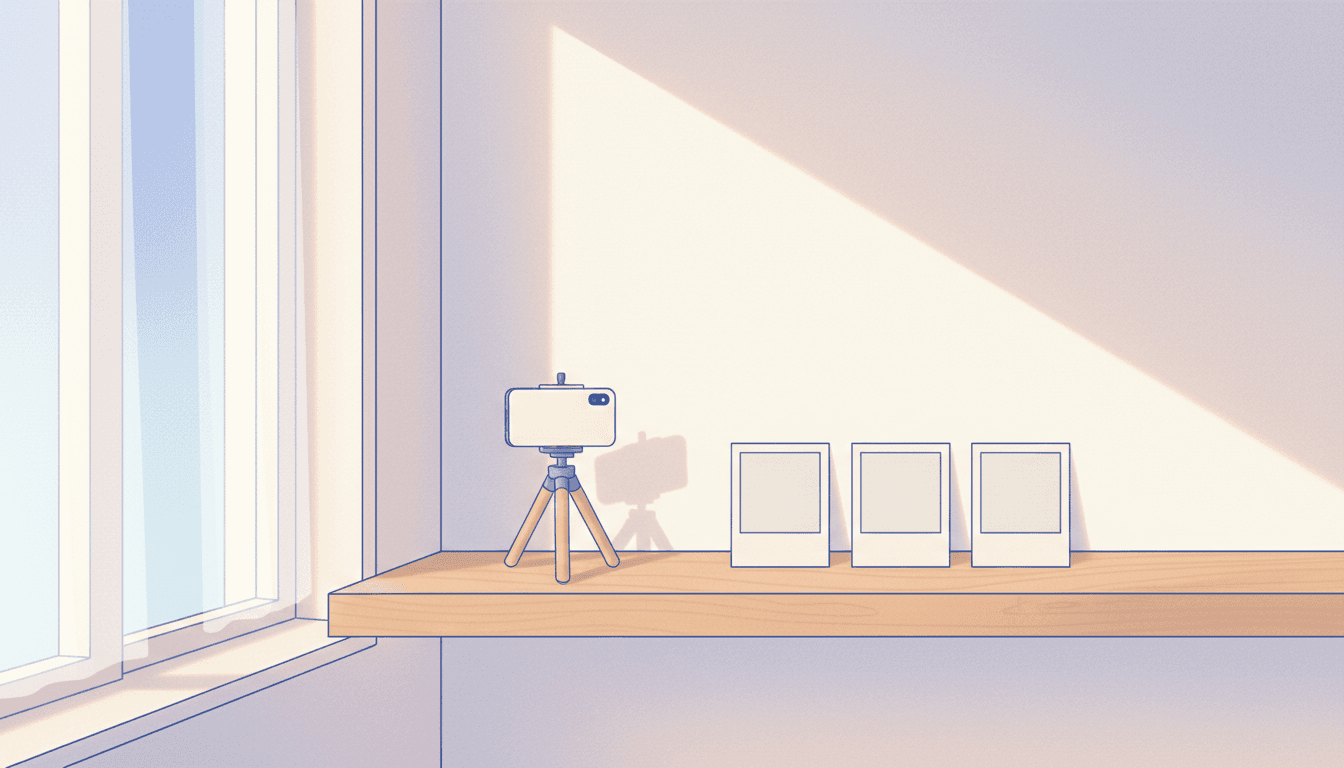
Good hair loss progress photos come down to keeping everything the same except time. Shoot the same four angles (front hairline, crown, temples and part line), in the same soft daylight, from the same distance and height, with dry unstyled hair, about once a week. Then compare photos a few months apart rather than last week against this week. That's the whole method. The rest of this post is the detail that makes it work.
Getting this right is most of what Strand, the private hair tracker I build, is for. If the photos can't be compared, nothing built on top of them means anything.
Why most progress photos can't be compared
Scroll back through a camera roll looking for your hair and you'll find shots under a bathroom downlight, shots in a car with the sun behind you, shots after a shower, shots after a haircut. Each one shows a slightly different amount of scalp, and almost none of that difference is your hair. Overhead light pushes through the hair and lights up the scalp. Wet hair clumps into strands and opens gaps. A phone held close to your head distorts whatever is in the middle of the frame.
So the goal isn't a flattering photo or a scary one. It's a boring one you can take again next week in exactly the same way.
Which angles should you photograph?
Four views cover the places hair loss usually shows up first. The American Academy of Dermatology lists a receding hairline, a slowly growing bald spot, a widening part and gradual thinning on top as common signs, and these angles catch all of them:
- Front hairline. Hair pushed back so the whole line is visible, camera level with your forehead.
- Temples. One shot of each side, turned so the corner of the hairline sits in the middle of the frame.
- Crown. The top and back of your head, which you can only see in photos anyway. A second phone, a mirror behind you or a timer helps here.
- Part line. Looking down at your part, parted where you always part it.
Pick your framing for each one and then don't change it. Consistency beats coverage. Four angles you repeat every week are worth more than ten you take once.
The setup: light, distance and hair
- Light. Stand facing a window with soft, indirect daylight. Avoid ceiling lights, direct sun and flash, which all exaggerate how much scalp shows.
- Time. Same room, roughly the same time of day, so the daylight is similar.
- Distance and height. Put the phone on a stand or a stack of books and use the timer. Holding it at arm's length changes the distance by a few centimetres every time.
- Hair. Dry, unstyled, no product, combed the way you usually wear it. If you've just had a haircut, note it, because shorter hair shows more scalp.
- Camera. Use the main rear camera if you can, with no filters or beauty mode, and don't edit the photos afterwards.
How often should you take hair loss progress photos?
Once a week is a good rhythm. It's often enough to become a habit and to give you plenty of photos to choose from if one comes out badly, and not so often that you start reading meaning into day-to-day noise.
The comparison is a different matter. Hair changes slowly. The AAD notes that hair loss can go on for months or years before you notice it, and that even a temporary bout of shedding after a stressful event usually takes six to nine months to settle back to normal thickness. So when you compare, compare across gaps of three to six months. Week-to-week differences are mostly light and angle.
One habit that helps more than it sounds: once this week's photos are taken, stop checking until next week. The record is captured. Looking again on Wednesday adds worry and no information.
How to compare your photos
Put two photos of the same angle side by side and look at fixed landmarks rather than the overall impression. At the part, how wide is the line where it meets the crown? At the temples, where do the corners sit against a forehead crease or the top of your ear? At the crown, how big is the area where the hair swirls out from the centre? A real change shows up in the same place across several pairs of photos. A single odd photo is almost always the setup.
Keep the photos private
This part gets skipped a lot. Weekly close-ups of your scalp end up in your camera roll, which usually means they're in a cloud backup, possibly in a shared album and occasionally resurfaced as a "memory" on your lock screen. If that bothers you, keep them in a separate private folder that isn't backed up, or use an app that stores them on its own.
That was a deliberate decision in Strand. There's no account. Your photos and history live in a private vault on your phone, kept out of cloud backups. They only leave the phone if you turn on AI analysis and tap Analyse, and then only that check-in's four photos are sent to be scored. You can export everything to a single file or delete everything at any time.
Using a hair loss tracker app instead of the camera roll
You can do all of this with a phone stand and a folder, and if that works for you, it works. What an app adds is help with the parts people drift on. Strand's guided capture takes the hairline, crown, temples and part line in the same order every time, and shows your last photo of each angle faintly over the camera so you can line the new one up. A quick light check warns you when a photo is too dark or too bright to be useful. Each check-in lands in a timeline where you can put this week beside any earlier week.
There's also an optional Hair Score, an AI estimate of how full your hair looks in each zone. It only shows a direction after a few analysed check-ins over about a month, and only when the change is bigger than normal photo-to-photo variation. It's an estimate from photos, not a measurement or a diagnosis, and Strand doesn't recommend treatments. For that, and for anything that worries you, talk to a GP or dermatologist. Having a few months of steady photos to show them is a good place to start that conversation.
Whatever you use, the method is the same: same angles, same light, same hair, once a week and patience. Strand is on Google Play if you'd like it to keep the routine for you.

Strand
A private hair tracker. The same four photos every week, an honest record you can look back on, and an optional AI Hair Score. No account, and your photos stay on your phone unless you choose AI analysis.


More from the devlog.
Does Oura track your alcohol intake? What a ring can and can't do
Your Oura ring or Whoop can show you what a night of drinking cost you, but it can't count what you actually drank. Here is the difference, and how to track your intake properly.
How to start a gratitude journal that actually sticks
I kept a gratitude journal that said the same three things every night until it died of boredom. Here is how to start a gratitude journal that lasts: keep it specific, keep it short and say it out loud.